

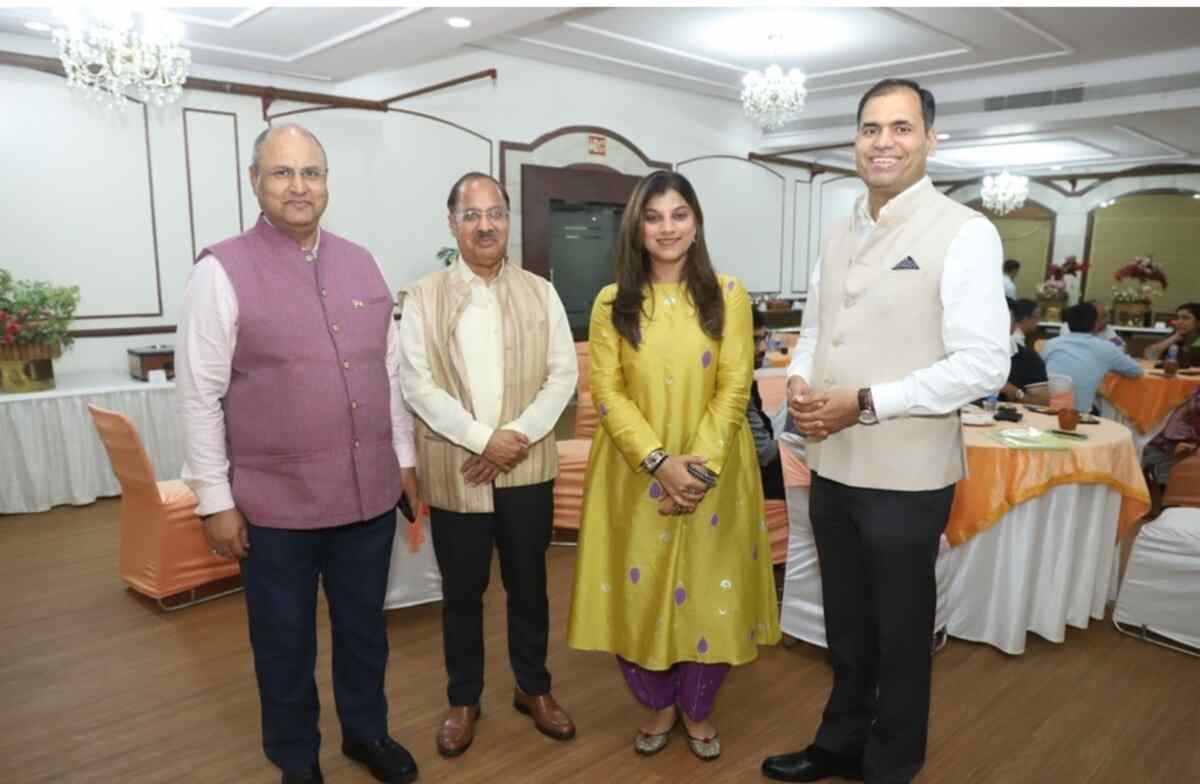
Nari Shakti 3.0, formally launched in New Delhi on 21 August, is asking a harder question than how to expand health awareness: can India build a connected preventive-health system capable of finding women at risk before disease becomes an advanced clinical crisis?
NEW DELHI | 22 AUGUST 2026: India’s cancer challenge is not only about how many hospitals it can build, how sophisticated its oncology centres become or how much treatment capacity it adds.
There is an earlier—and arguably more uncomfortable—question.
How many women are entering the healthcare system only after the system has already missed multiple opportunities to find them?
That question sat at the centre of the launch of Nari Shakti 3.0, the annual women’s-health initiative of Mediways Health Foundation, held at the Chelmsford Club in New Delhi on 21 August.
The launch itself was deliberately a precursor. The larger conversation is scheduled for 25–26 September 2026 at The Leela Palace, New Delhi, where policymakers, clinicians, public-health professionals, technology leaders, corporate decision-makers and civil-society institutions are expected to examine a proposition that is easy to articulate but considerably harder to operationalise: how do we create an intelligent health architecture in which a woman does not remain undiagnosed simply because the system failed to identify her risk early enough?
That distinction matters
For years, women’s health interventions have been built around awareness drives, screening camps, individual hospital initiatives and fragmented public-health programmes. Each has value. But a screening event is not a screening system. Detection is not continuity of care. And identifying an abnormality means little if the woman subsequently disappears somewhere between the camp, diagnostic laboratory, specialist consultation and treatment centre.
The real test begins after the screening ends.
Was the woman identified as being at risk? Was the finding recorded? Was she contacted again? Did she complete the diagnostic pathway? Was an appropriate specialist available? Could she afford the next investigation? Was she linked to treatment? Did anybody know whether she eventually received it?
These are not administrative questions. They are the difference between activity and outcome.
It is this gap that Nari Shakti 3.0 is attempting to bring into sharper focus.
“The real weakness is often not the absence of individual healthcare capabilities; it is the absence of connectivity between them,” said Ektaa Rathi, CEO, Mediways Health Foundation. “If a woman is screened but is subsequently lost between risk identification, diagnosis and treatment, the system has not succeeded. Our objective is to examine how prevention, data, clinical pathways and institutional accountability can work as one continuum rather than as isolated interventions.”
That is an important reframing.
For Nari Shakti 3.0, the phrase “intelligent systems” cannot simply become another convenient reference to artificial intelligence. An intelligent health system should be able to connect community outreach with risk identification; risk with screening; screening with diagnostics; diagnostics with specialist referral; referral with treatment; and treatment with follow-up.
Technology can help at several points. AI can support risk stratification, imaging, clinical decision-support and population-level pattern recognition. Digital systems can improve longitudinal records and referral tracking. But technology without access can simply digitise an existing inequality.
The harder problem remains organisational.
A woman in an underserved community does not experience healthcare as separate departments of public health, CSR, hospital operations, technology and social development. She experiences one journey. The system, however, frequently treats that journey as several unrelated transactions.
That fragmentation becomes particularly consequential in cancer.
“Cancer outcomes are influenced long before a patient enters an oncology department,” said Dr Mrinal Kant Pandey. “When disease is detected late, we must also examine what happened earlier—whether risk was recognised, whether screening was available, whether abnormal findings were escalated and whether referral actually resulted in care. Improving outcomes therefore requires us to strengthen the pathway before treatment becomes the primary intervention.”
The point is not to suggest that every cancer can be prevented or detected at an early stage. Nor can technology eliminate biological uncertainty.
But a healthcare system can be judged on whether avoidable delay is designed out of it.
That requires moving the discussion from individual awareness to institutional responsibility.
Nari Shakti 3.0 has therefore structured its September conclave around five interconnected questions rather than a collection of generic panel discussions.
The first is early detection: how can accessible and scalable pathways identify important women’s-health conditions earlier?
The second is institutional prevention: how can preventive healthcare move from recommendation to routine organisational practice?
The third addresses AI and women’s health, but with a necessary emphasis on responsible deployment, inclusion and health equity rather than technology for its own sake.
The fourth examines CSR and female health initiatives, where perhaps one of the sector’s biggest opportunities lies.
India’s corporate social responsibility ecosystem has financed an enormous range of health interventions. The next evolution should be to ask more demanding questions of that expenditure.
Not simply: How many camps were conducted?
But: How many women at risk were identified? How many completed diagnostics? How many entered treatment? What changed because the intervention existed?
The distinction is critical.
CSR in healthcare becomes strategically valuable when it begins financing health architecture rather than isolated health activity—particularly systems that public institutions, hospitals, technology providers and credible community organisations can ultimately scale.
The fifth conversation moves into public-health initiatives and last-mile access, because even the most sophisticated screening technology has limited value if the woman most likely to benefit from it cannot reach it.
“Early detection cannot become a privilege attached to income, postcode or proximity to a major hospital,” said Dr Urvashi Mittal. “The real opportunity is to take diagnostic intelligence closer to women and then ensure that what is detected at the community level is connected reliably to the formal healthcare system. Access without continuity is incomplete healthcare.”
The August 21 gathering reflected the intentionally cross-sector nature of that discussion.
Those present included Prof. (Dr.) Ramakant Dwivedi, Head of the MERI Centre for International Studies and Director of the India Central Asia Foundation; Brijesh Srivastava, Co-Founder, Mediways Health Foundation; Manish Mangal, Senior Vice President, Neo Broker; Monieka Khera, Shri Anand Mishra , Dr Prakhar Singh ,Co- Founder Osvi Healthcare along with members, advisors and stakeholders from different professional backgrounds.
Their presence also underlines something the healthcare sector occasionally overlooks: women’s preventive health is no longer exclusively a clinical subject.
It is simultaneously a question of public policy, technology architecture, institutional financing, behavioural adoption, data, economics and last-mile execution.
That is also where the connection with Viksit Bharat deserves to be treated seriously rather than rhetorically.
A woman who receives an earlier diagnosis is not merely a healthcare statistic. Delayed illness can affect household income, workforce participation, caregiving responsibilities, productivity and catastrophic family expenditure. Preventive health therefore sits closer to economic and development infrastructure than conventional welfare terminology suggests.
The September conclave will ultimately conclude with the proposed Nari Shakti Declaration, intended to consolidate the discussions into a shared framework for action.
But declarations themselves do not change health outcomes.
Systems do.
The most important question facing Nari Shakti 3.0 will therefore emerge after the panels have ended at The Leela Palace.
Can hospitals share responsibility beyond their walls? Can technology companies design for the woman at the last mile rather than only for sophisticated institutions? Can CSR capital finance longitudinal outcomes rather than one-day interventions? Can community organisations become reliable entry points into organised healthcare? And can screening be connected to a mechanism that refuses to lose the patient after an abnormal result?
Those questions make the initiative worth watching.
The credibility of Nari Shakti 3.0 will not ultimately be measured by the size of its September audience, the prominence of its speakers or the number of institutions represented in the room.
The harder metric will come later.
Did the system find the woman when medicine still had more options?
If Nari Shakti 3.0 can move that question from conference discussion to operating reality, it will have addressed something considerably more important than awareness.
It will have addressed the architecture of early action.

