

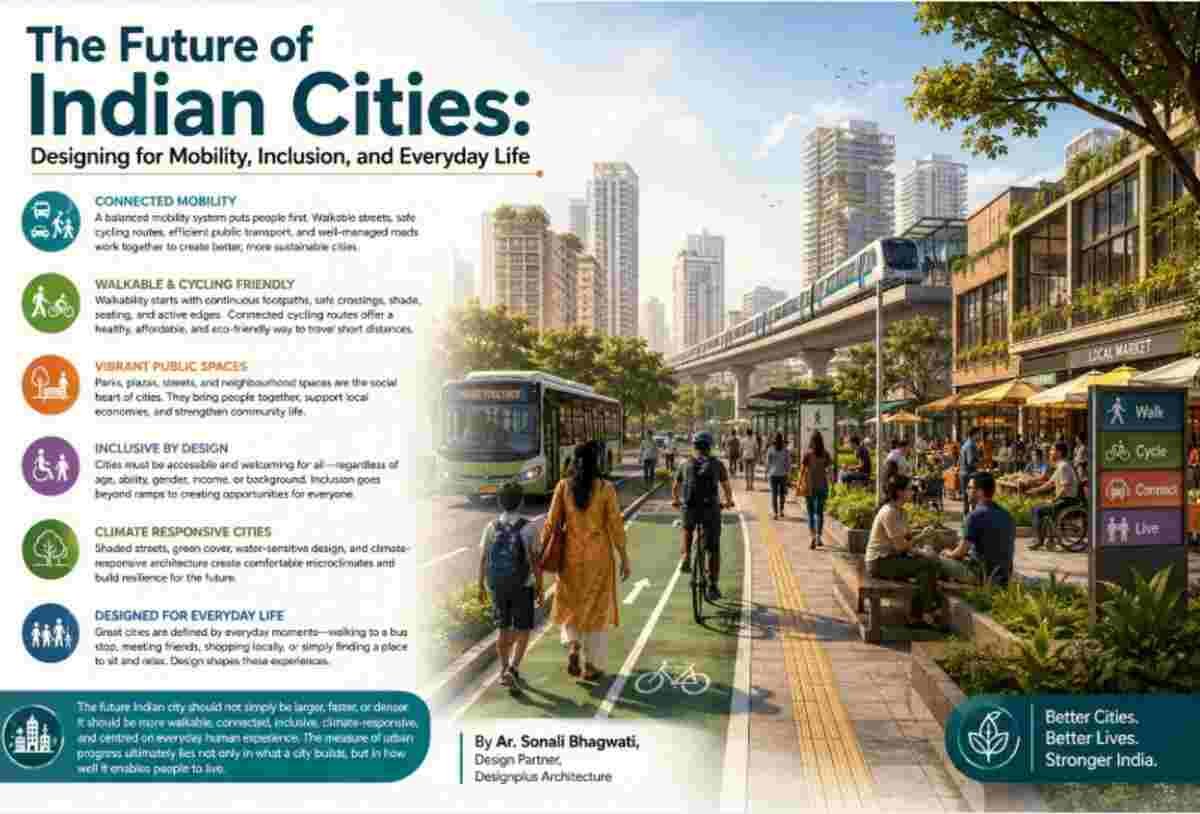
India’s cities are at a defining point in their evolution. As urban populations grow and cities expand, the question is no longer simply how much can be built, but how well the built environment can support everyday life. The future of Indian cities will depend on how effectively they respond to mobility, accessibility, climate, public life, and the needs of diverse communities.
Urban planning has traditionally placed considerable emphasis on roads, traffic movement, and infrastructure capacity. The next phase needs to establish a more balanced hierarchy, where pedestrians, cyclists, public transport, and private vehicles are considered as part of one connected mobility system.
Walkability needs to become a fundamental part of urban planning rather than an afterthought. A walkable city is not created simply by widening footpaths. It requires continuous pedestrian networks, safe crossings, adequate lighting, shade, seating, accessible ramps, active street edges, and convenient connections to public transport. These details determine whether a street feels usable and safe in everyday life.
Cycling also has an important role to play. With many daily journeys covering relatively short distances, dedicated cycling routes can provide an efficient and sustainable alternative to private vehicles. However, cycling infrastructure needs to be continuous and connected to neighbourhoods, workplaces, schools, transit stations, and public spaces. Isolated cycling tracks cannot create a cycling city. Routes need to be safe, shaded, clearly defined, and integrated into the larger urban network.
The quality of public space is equally important. Parks, plazas, streets, markets, institutional campuses, and neighbourhood gathering spaces form the social infrastructure of a city. They provide opportunities for people to meet, pause, interact, and participate in community life. Public spaces should therefore not be treated as leftover areas between buildings. They need to be planned as essential components of the urban fabric.
Inclusion must also extend beyond physical accessibility. Cities accommodate people with different ages, abilities, occupations, incomes, and patterns of movement. Urban environments need to recognise these differences through accessible infrastructure, safer streets, varied public spaces, and better connections between residential areas, employment centres, education, healthcare, and recreation.
Climate will further shape the future of Indian cities. Increasing heat and changing weather patterns make shaded streets, tree cover, water-sensitive planning, natural ventilation, and climate-responsive public spaces increasingly important. Urban design can help create comfortable microclimates through the careful placement of vegetation, shaded walkways, built form, and open spaces.
The everyday experience of a city is often shaped by its smallest moments: walking to a bus stop, cycling to work, finding shade on a hot afternoon, sitting in a public space, crossing a busy street, or meeting someone in a neighbourhood market. These experiences rarely appear in discussions about major infrastructure, yet they define how a city is lived.
India’s independence was a transformation of political and social identity. The next chapter of that journey can be reflected in cities that offer people greater freedom to move, participate, connect, and access opportunities.
The future Indian city should not simply be larger, faster, or denser. It should be more walkable, connected, inclusive, climate-responsive, and centred on everyday human experience. The measure of urban progress ultimately lies not only in what a city builds, but in how well it enables people to live.
By Ar. Sonali Bhagwati, Design Partner, Designplus Architecture

