

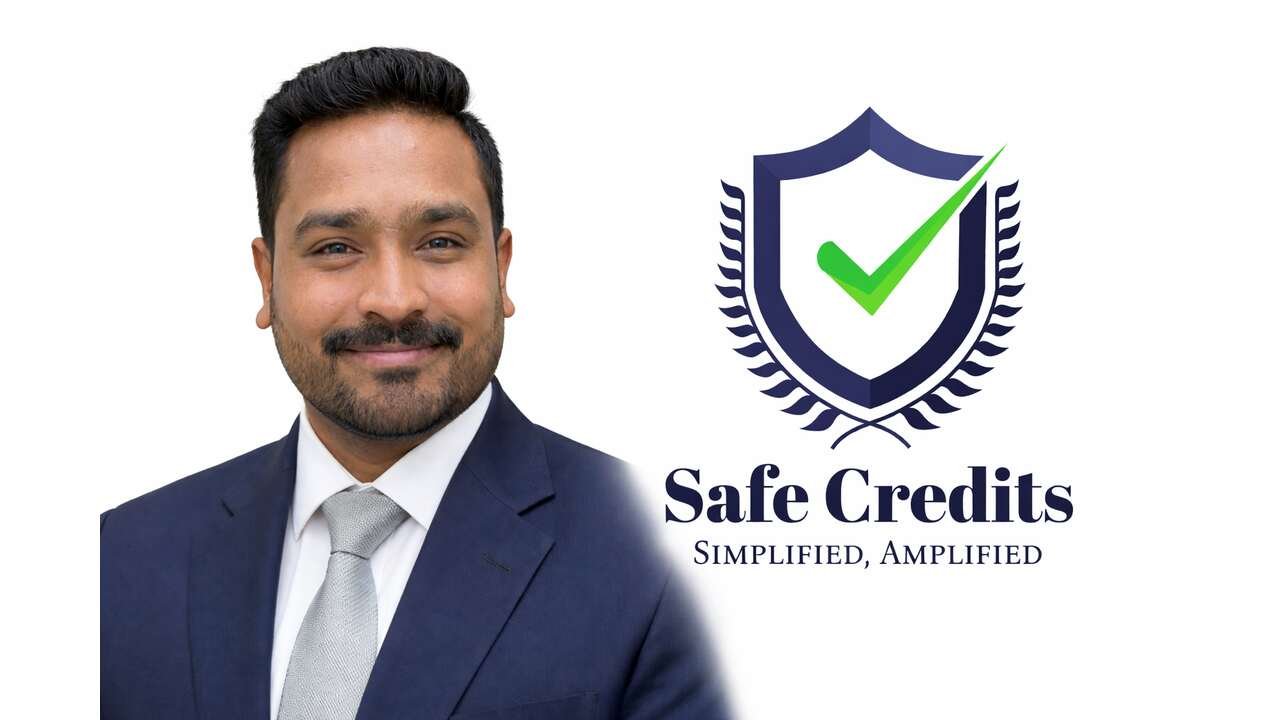
In India’s vast distribution economy, trade has long depended on trust. Medicines move from factories to wholesalers, from wholesalers to chemists, and finally to patients, often on informal credit terms. For decades, delayed payments and bad debts were accepted as a cost of growth rather than a risk to be managed. Mannuri Vamshi Krishna, Founder & CEO, SafeCredits, encountered this reality not as an observer, but as a participant.
His entry into the world of trade began early. After losing his father at the age of 13, he started working in a medical store to support his family. “That shop became my classroom,” he says. “I learned how medicines move, how distributors think, and how deeply business depends on trust.”
Over time, this early responsibility evolved into hands-on experience across pharma retail, wholesale, and supply chain operations, and eventually into running his own distribution business. It was there that a pattern became impossible to ignore. “Stock was usually available and demand was steady,” he recalls. “What slowed growth was hesitation around extending credit. Wholesalers delayed supplies not because they lacked inventory, but because they were unsure who would pay on time.”
In India’s pharma trade, credit decisions are often shaped by relationships and instinct rather than structured data. Payment delays surface only after they become habitual, and once bad debts set in, the tightening of credit ripples across the network. “Trust isn’t the problem,” Mannuri says. “The problem is that trust has no structure around it. There is no early warning system, no shared visibility of risk. When defaults happen, they appear sudden, but the warning signs were always there.”
The first attempt to address this imbalance took shape as Medvolant, also known as MedxBid, a digital platform aimed at improving efficiency in pharma procurement. Yet as adoption grew, a deeper constraint revealed itself. “We realised supply was not the real issue,” he explains. “The real bottleneck was uncertainty around credit. People weren’t holding back orders because they lacked products, but because they didn’t know who would pay on time.”
This insight led to the creation of MedScore, a pharma-focused credit intelligence solution with a patented behaviour-based scoring mechanism. It introduced the idea that credit should be measured not as a static financial snapshot, but as a living pattern of behaviour. As MedScore gained adoption, another shift occurred. “Delayed payments and bad debts were not unique to pharma,” Mannuri says. “They were everywhere — FMCG, manufacturing, automotive, B2B trade. The problem was universal.”
SafeCredits emerged from this recognition as a sector-agnostic platform built for businesses operating through distributor and dealer networks. It was designed not merely to identify risk, but to guide commercial decisions. “SafeCredits is not just a score,” Mannuri explains. “It is a system that tells you where it is safe to grow, when discipline is needed, and how to balance ambition with protection.”
Unlike traditional credit checks that are performed once at onboarding, SafeCredits treats credit health as something that must be continuously observed. The platform digitally onboards distributors, automates KYC and business verification, and integrates with ERP systems to track transactions, receivables, and payment behaviour in near real time. Its AI engine monitors patterns such as increasing delays, sudden spikes in credit utilisation, and stress spreading across connected accounts.
“When patterns begin to change, we flag them early,” he says. “Our goal is to give teams foresight, not hindsight.”
At the centre of this system is a personalised, role-based AI assistant that acts as a virtual partner for credit, finance, or sales teams, guiding daily workflows and risk actions. To close the loop, SafeCredits automates payment follow-ups through reminders, IVR calls, and structured escalation workflows. “Delayed payments don’t just hurt balance sheets,” Mannuri observes. “They disrupt entire supply chains. If we intervene early, we protect relationships as well as cash flows.”
Now positioned for deployment across FMCG, manufacturing, industrial supplies, logistics, and other B2B ecosystems where trade credit drives distribution, SafeCredits is built for large enterprises and fast-growing SMEs alike. The platform enables corporates managing thousands of distributors to standardise governance without increasing headcount.
“Managing distributor networks that can run into the thousands is impossible manually,” Mannuri says. “Automation is the only way to make discipline scalable.”
The impact extends beyond corporates to the distributors themselves. Transparent credit scores reduce uncertainty and reward consistent behaviour with higher limits and faster approvals. “When distributors know exactly where they stand, they can plan better and grow with confidence,” he explains. “Over time, they build a credible financial identity.”
Looking ahead, he sees B2B credit moving from instinct to intelligence. “India Stack makes it possible to monitor businesses in real time across networks,” he reflects. “Our ambition is to become the trusted credit layer across India’s supply chains, where growth is no longer blind and risk is no longer hidden.”
SafeCredits did not emerge from theory alone, but from years of lived experience within the trade it now serves. Much like the supply chains it seeks to stabilise, the story of SafeCredits continues to unfold — shaped by every distributor it scores, every payment it predicts, and every decision it helps businesses take with greater confidence.

