

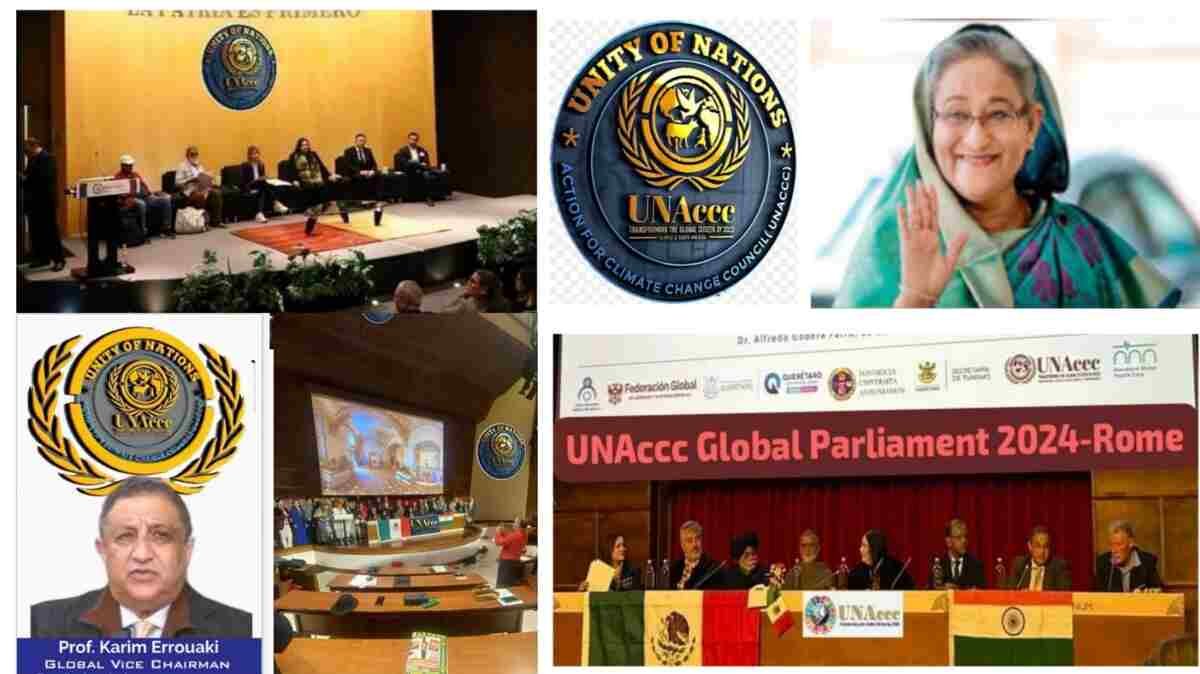
Geneva : The unfolding extradition crisis involving former Bangladeshi Prime Minister Sheikh Hasina has placed South Asia at a delicate crossroads where law, diplomacy, and human conscience intersect. What might otherwise have remained a routine legal request has instead evolved into a matter of global concern, raising difficult questions about justice, political accountability, and the responsibility of nations to uphold international human rights standards. In this charged environment, a detailed diplomatic proposal from the Unity of Nations Action for Climate Change Council (UNAccc), headquartered in Geneva, has introduced a carefully balanced framework that seeks justice without surrendering fairness.
Prepared under the leadership of Ambassador Professor Karim Errouaki, UNAccc’s High Representative for Foreign Affairs and Human Rights, the proposal recognizes the gravity of Bangladesh’s demand for accountability while warning against actions that could compromise fundamental legal principles. The document does not argue for impunity, nor does it dismiss the seriousness of the allegations involved. Instead, it calls for a process rooted in neutrality, transparency, and international law—values that lie at the core of global justice systems.
A central concern raised in the proposal relates to the principle of non-refoulement, a cornerstone of international humanitarian law. This principle bars the transfer of any individual to a jurisdiction where they face a real risk of persecution, torture, or irreversible punishment driven by political motives. According to UNAccc, the current political volatility in Bangladesh, combined with concerns about judicial independence and the possibility of capital punishment, creates conditions under which direct extradition would pose serious legal and moral risks.
The proposal also underscores the importance of the right to a fair trial. International legal standards demand independent courts, presumption of innocence, adequate defense, and protection from retroactive or politically motivated prosecution. Where these guarantees cannot be credibly ensured, international law permits states to withhold extradition, even in the presence of bilateral agreements. In such cases, the duty to protect human rights supersedes treaty obligations, reaffirming that justice must be substantive rather than symbolic.
From India’s perspective, the Unity of Nations Action For Climate Change Council (UNAccc) document frames the issue as one involving sovereign discretion and national interest. India’s right to grant asylum and assess extradition requests on humanitarian grounds is well established. The proposal stresses that India must weigh not only legal considerations, but also regional stability, domestic harmony, and the safety of vulnerable communities. A decision perceived as unjust or politically pressured could inflame tensions, weaken diplomatic relationships, and undermine India’s long-standing image as a principled democracy committed to pluralism and the rule of law.
Rather than advocating a simple refusal or compliance, Ambassador Prof. Errouaki introduces a third and more constructive option: the transfer of Sheikh Hasina to a neutral member state of the Organization of Islamic Cooperation under strict international supervision. This approach draws on historical precedents where politically sensitive cases were handled outside the immediate regional context to ensure credibility and impartiality. By relocating the judicial process to neutral ground, accountability can proceed without exposing the accused to political vendetta, mob violence, or disproportionate punishment.
The proposal outlines how such a framework could serve all stakeholders. Bangladesh’s demand for justice would be addressed through lawful investigation and adjudication. India would avoid allegations of shielding or interference, while reinforcing its commitment to international law. Most importantly, the integrity of justice itself would be preserved, demonstrating that fairness and accountability are not mutually exclusive goals.
Unity of Nations Action For Climate Change Council (UNAccc) further recommends the involvement of international institutions, including oversight by the UN human rights system and the presence of independent legal observers. Any transfer, the proposal insists, must be conditional upon binding guarantees: no death penalty, full due process, access to independent counsel, and continuous international monitoring. These safeguards are presented not as concessions, but as minimum standards required to protect human dignity.
In its closing message, the proposal frames the moment as a defining test for global diplomacy. Justice pursued through political pressure risks deepening divisions and fueling instability. Justice grounded in neutrality, law, and humanity, however, can restore faith in international norms. As Ambassador Professor Karim Errouaki aptly reflects, justice that abandons fairness ultimately loses its meaning. By choosing a path that prioritizes neutral justice, nations have an opportunity to affirm that, even amid crisis, human rights and the rule of law remain non-negotiable pillars of the international order.
For more information:

