

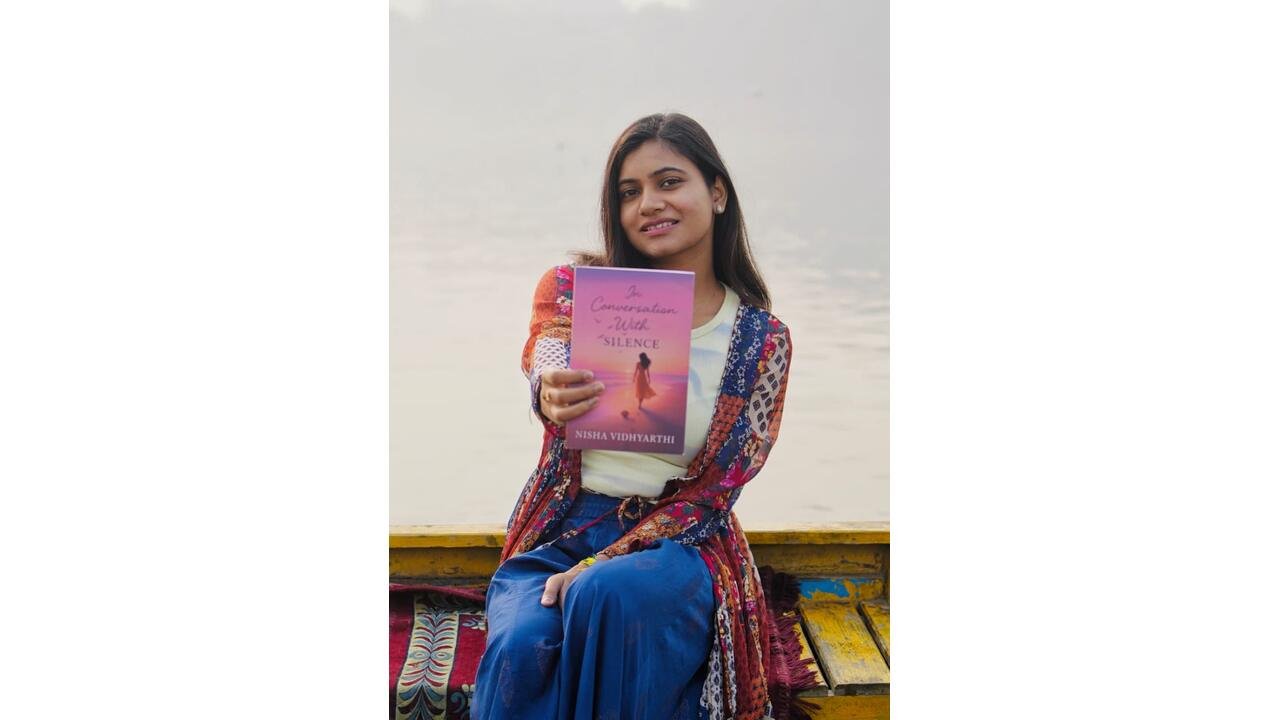
In this conversation, the poet behind In Conversation With Silence reflects on the power of silence, self-liberation through art, and the rhythm of human experience. The book invites readers to pause, listen, and engage with the spaces that hold meaning — where words meet silence and emotion finds its voice.
Through this dialogue, the poet shares insights into her creative process, how poetry shapes perception, and the ways in which written words can become both reflective and transformative.
Q1. Your book is titled In Conversation With Silence. What does silence mean to you as a presence — something passive, or something that actively speaks back?
When I speak of silence, I don’t see it as something passive or empty. To me, silence has a quiet intensity. It actively participates — especially in spaces where it is ignored or overlooked. It exists everywhere, yet there are moments when it goes unfelt.
I often think of silence as the space between words. The words are heard and carry meaning, but the spaces exist simply to hold them — and without those spaces, meaning would collapse. In that sense, silence holds as much significance as sound itself. It is just as alive.
For each of us, silence, and so this book carries a different terrain waiting to be explored — something to be listened to, touched, and felt in our own way.
Q2. Do you believe poetry can be a form of self-liberation? If so, what were you freeing yourself from while writing this book?
I believe any art form can become a path to self-liberation. It creates a space where we are able to reach parts of ourselves that often remain unexplored or hidden. While writing this book, there were many moments when I felt more aware, more still — paused in a way that allowed me to reflect on the fast-moving, competitive nature of existence, where survival often feels tied to constant motion and comparison.
Poetry gave me the distance to step back and observe life from a wider lens — not as a participant rushing through it, but as a witness trying to understand it. In that process, I’m not entirely sure what I was freeing myself from. Perhaps it was the world. Or perhaps, more honestly, it was myself.
Q3. How do you use poetry as a way to reflect on or respond to the world around you?
Poetry gives me room to speak and, equally, to listen. Through it, I explore the limits of my own understanding and the perspectives I encounter through others.
Within poetry, I can be both a learner and an observer — someone who questions openly, yet remains gentle before meaning. It becomes a reflective surface where the world appears not as it looks, but as it feels: layered, delicate, and deeply expressive.
Q4. How do you think about rhythm and musicality in your poetry, and what role does it play in the reader’s experience?
I’ve read widely and explored poetic devices, and I’ve also taken courses to understand rhythm and rhyme more consciously. While such elements do appear in my work, I believe the true music of poetry comes from meaning rather than technique alone.
When words create an image in the mind, a quiet rhythm naturally follows. That internal cadence allows the poem to be felt, not just read. It shapes a mood — something subtle that stays with the reader even after the poem ends.
Q5. What experiences and reflections shaped the themes of your poetry, and how did they influence the way your poems are structured and voiced?
The themes of my poems grow out of the emotions I’ve lived through, as well as those I’ve witnessed in others. Meaningful conversations, followed by stretches of silence and inward reflection, have helped me reach inner layers that often remain unspoken.
Because of this, my poetry naturally moves toward a free-flowing form. The openness of the structure reflects a mind in search — one that resists rigid boundaries. The tone stays fluid and sincere, as emotions rarely arrive in neat patterns; they surface quietly, honestly, and in their most human form.
Q6. When a poem is finished, how do you know it’s complete — when the words settle, or when the silence returns?
For me, there are really two kinds of poems. Some reach a natural completion when they leave behind a sense of peace — a stillness that doesn’t diminish, but quietly blooms. In those moments, the poem feels whole, as though it has settled into itself.
Then there are poems that continue to feel open, unfinished — not because they are incomplete, but because they still hold room for further exploration. I carry those poems with me. Perhaps, when I write another book, their ideas will move forward in a new form. After all, every ending is also the beginning of something else.
Immerse yourself in the reflective world of In Conversation With Silence.Get your copy on Amazon today

