

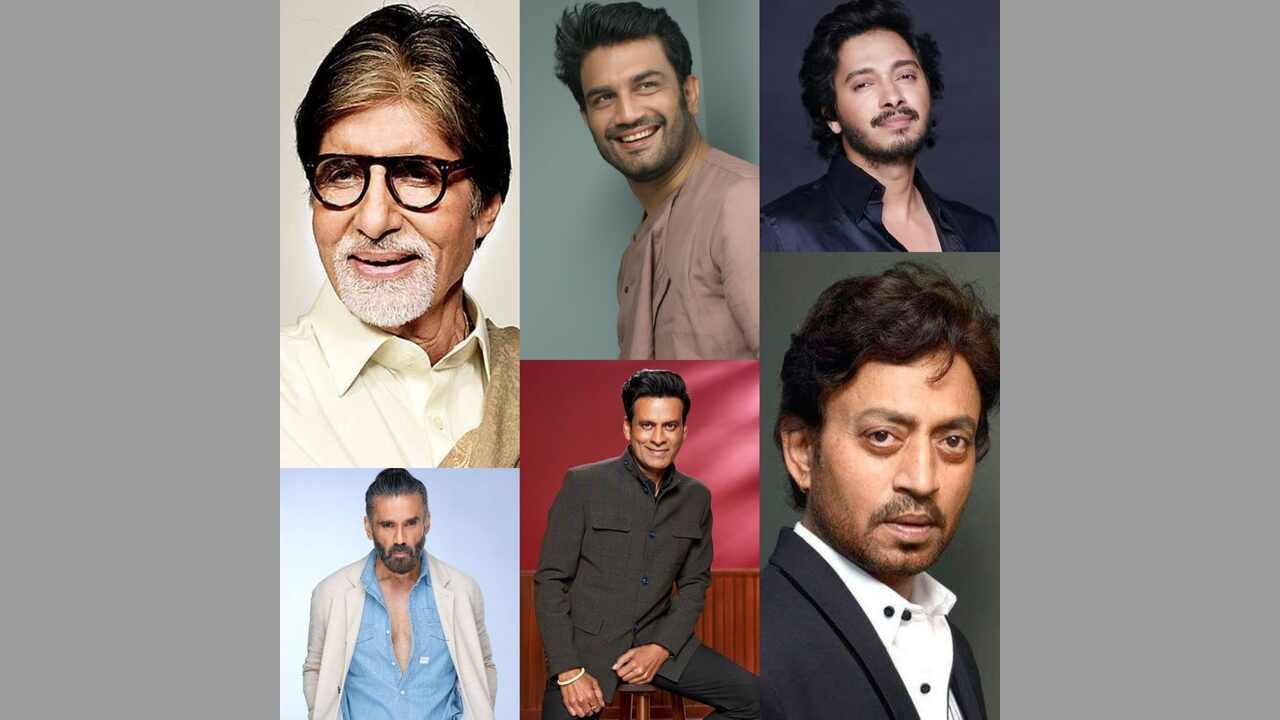
In an industry where appearance often takes centre stage, there exists a rare group of actors whose voices have become as iconic as their on-screen presence. A pause held just long enough, a baritone that fills silence with authority, or a soft-spoken modulation that draws viewers inward — these vocal qualities have shaped performances and etched characters into public memory.
Yet what makes these actors truly remarkable is not just that their voices became their signature — it is that they refused to be confined by them. They moved beyond stereotypes, beyond typecasting, and proved that a distinctive voice can be a powerful tool without becoming a creative cage.
Let’s take a closer look at some actors whose voices became unforgettable — but never limiting.
Amitabh Bachchan: The Baritone That Redefined Stardom
When conversations turn to commanding voices in Indian cinema, Amitabh Bachchan inevitably leads the list. His deep baritone is not merely a vocal trait — it is an institution in itself.
From the simmering intensity of Deewar to the tender vulnerability in Piku, Bachchan has demonstrated how a voice can carry both authority and fragility. Whether playing a spectral guardian in Bhoothnath or hosting millions nightly on Kaun Banega Crorepati, his vocal presence commands attention without overpowering emotion.
In his early years, his baritone complemented the “angry young man” persona that defined 1970s Bollywood. Over time, however, he evolved into roles that required warmth, humour, restraint and even self-parody. The same voice that once symbolised rebellion later conveyed paternal affection, philosophical depth, and comic timing.
Bachchan’s career stands as proof that a powerful voice can enhance versatility rather than restrict it.
Suniel Shetty: The Husky Voice Behind the Action Hero
In the 1990s, Suniel Shetty emerged as one of Bollywood’s prominent action stars. His husky, heavy voice perfectly complemented his rugged screen image. In action dramas and thrillers, that vocal depth reinforced strength and stoicism.
However, as the industry evolved, so did Shetty. Rather than remaining confined to action roles, he embraced comedy with surprising ease. Films like Phir Hera Pheri and De Dana Dan showcased a lighter, more playful side of his personality.
His voice, once associated primarily with intensity, adapted to humour and chaos seamlessly. The shift demonstrated that vocal texture does not dictate genre. Shetty’s journey underscores how reinvention is possible when an actor refuses to be boxed in by early success.
Irrfan Khan: The Power of Quiet Modulation
Unlike booming baritones or theatrical projection, Irrfan Khan possessed something rarer — a voice that thrived in restraint. His speech was marked by subtle pauses, understated emotion, and an almost conversational intimacy.
In The Lunchbox, his dialogue delivery carried loneliness and longing without dramatic flourish. In Life of Pi, his narration anchored a visually grand tale with emotional grounding. Whether in Hindi Medium or Piku, Irrfan’s voice never tried to dominate — it invited audiences closer.
His vocal style proved that impact does not always come from loudness. Sometimes, the softest inflection leaves the deepest mark. Irrfan Khan redefined what a “signature voice” could mean — not thunderous, but thoughtful.
Sharad Kelkar: From Dubbing Powerhouse to Screen Presence
For many audiences, Sharad Kelkar became instantly recognisable when he lent his voice to the Hindi version of Baahubali: The Beginning and its sequel, voicing the titular character. His deep, resonant tone added gravitas to an already epic narrative.
The dubbing success could easily have typecast him as a “voice specialist.” Instead, Kelkar expanded his repertoire. He embraced intense on-screen roles and portrayed historical and authoritative characters with conviction.
His journey highlights an important point — while dubbing showcased his vocal strength, it did not define the limits of his acting career. He ensured his physical presence matched the power of his voice, building a distinct identity beyond the recording studio.
Manoj Bajpayee: Intensity That Cuts Through Silence
Few actors embody layered intensity like Manoj Bajpayee. His voice carries a grounded realism that aligns perfectly with morally complex and emotionally layered characters.
From the raw authenticity of Satya to the gripping tension of Gangs of Wasseypur, Bajpayee’s dialogue delivery enhances narrative depth. In the digital era, his performance in The Family Man reaffirmed his ability to combine humour, vulnerability, and suspense — often within a single scene.
His voice may draw viewers in, but it is his adaptability across genres — crime, thriller, drama, satire — that sustains his longevity. Bajpayee proves that a strong vocal identity works best when supported by fearless experimentation.
Shreyas Talpade: The Surprise Beneath the Familiar Tone
Audiences long associated Shreyas Talpade with light-hearted, comic, and slice-of-life roles. His voice carried an approachable warmth that suited humorous storytelling.
However, he surprised many when he lent his voice to the Hindi version of Pushpa: The Rise. The shift revealed a different texture — intense, massy, and commanding. It demonstrated the flexibility hidden within what many perceived as a “soft” voice.
Talpade’s transition into dubbing a larger-than-life character showcased that vocal identity is rarely one-dimensional. With the right modulation, even familiar tones can take on unexpected power.
Beyond the Voice: Craft Over Comfort Zones
What unites these actors is not merely that they possess distinctive voices. It is that they refused to let that distinctiveness become a stereotype.
A heavy baritone did not confine them to authority figures. A husky texture did not restrict them to action roles. A quiet modulation did not prevent them from commanding global screens. Instead, each actor demonstrated that voice is a tool — one of many — in the craft of performance.
In cinema, relatability is built through authenticity, emotional truth, and evolution. While audiences may initially be drawn to a powerful vocal signature, they remain invested because of layered performances and consistent reinvention.
These actors remind us that identity in art is fluid. A signature voice may open the first door, but it is versatility, courage, and commitment that keep it open.
In an industry constantly searching for novelty, they stand as enduring examples that sometimes, the most powerful presence is not just seen — it is heard.

