

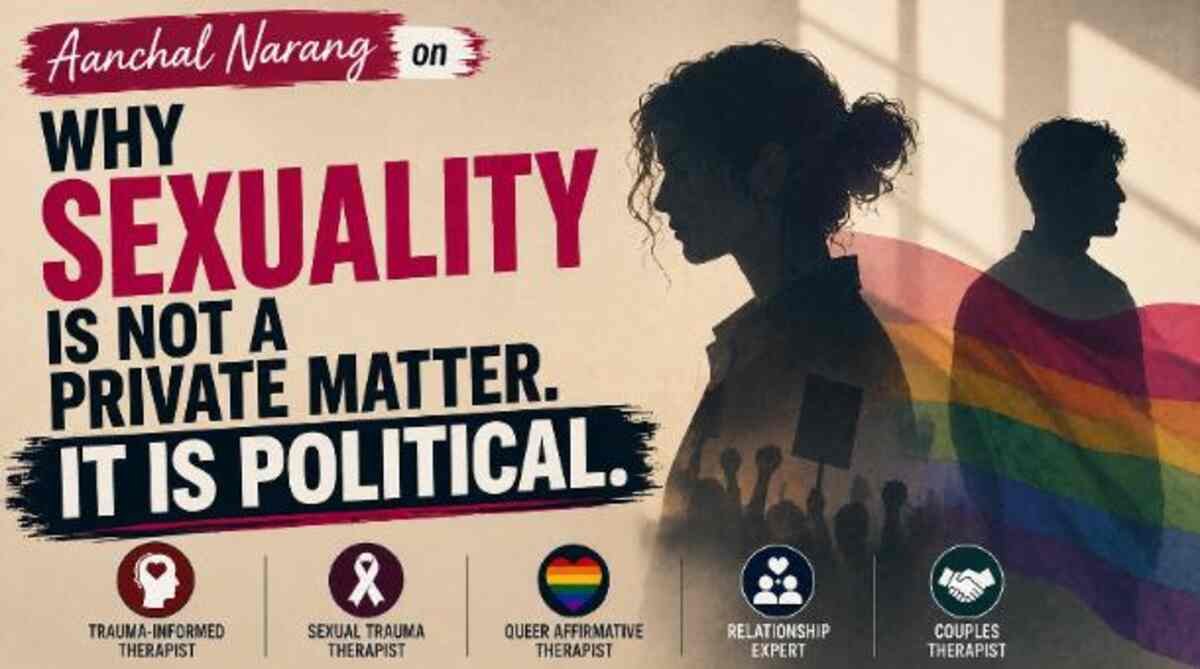
We are often told that sexuality is private. Who you love, what happens in your bedroom, whether you want children, who you are attracted to, and what gives you pleasure are all supposed to remain behind closed doors.
But there is a contradiction here.
If sexuality is truly only private, why are we taught so early who we are allowed to desire?
- Why is a woman judged differently for having multiple partners?
- Why is a man questioned when he does not want sex?
- Why do queer people still have to explain their relationships?
- Why might an unmarried person hesitate before asking a doctor a sexual-health question because they fear judgement?
Because sexuality is personal, but it does not exist outside society. And that is precisely why sexuality is political.
Before You Discovered Your Sexuality, Society Had Already Given You Rules
Most of us did not consciously choose our beliefs about sex. We inherited them.
A girl may grow up hearing that “good girls” do not talk about sex. A boy may learn that saying no makes him less masculine. Someone may be taught that desire is shameful, pleasure should come with guilt, or marriage is the only legitimate place for intimacy.
Sometimes the message is spoken. More often, it is absorbed through silence, jokes about bodies, reactions to questions about sex, or the discomfort surrounding masturbation and sexual relationships.
Eventually, society’s voice can become our own.
“But Why Call Something So Personal Political?”
This is one of the questions that comes up when Aanchal Narang, a therapist working with sexuality, relationships and trauma, discusses sexuality and mental health.
For Aanchal, calling sexuality political does not mean turning every sexual experience into a public debate. It means recognising who gets to choose, who gets judged, whose boundaries are respected, who gets access to care, and whose desires are considered legitimate.
The World Health Organization similarly recognises that sexuality is influenced by political, cultural, legal, economic and social factors, while sexual health involves rights including equality, privacy, information, expression and freedom from discrimination.
Think About the Simple Act of Saying “No”
A person should be able to say no to sex without being punished for it. Yet many people have heard:
“But we’re married.”
“If you loved me, you would.”
“You never say no to me.”
The issue is bigger than one uncomfortable conversation. It is about whether someone else’s access to your body is treated as negotiable.
That makes consent a question of power and bodily autonomy, not simply communication.
The Politics of the “Good” Sexual Person
We are quietly taught what a “good” sexual person looks like: desirable, but not promiscuous; experienced, but not “too experienced”; confident, but not demanding.
These contradictions can become internal rules. People begin asking, “Am I too much?”, “Am I not enough?”, or “Should I even want this?”
What feels like personal insecurity can sometimes be years of social conditioning.
“What If I Feel Ashamed of What I Want?”
This is a question people often carry silently.
A fantasy. A kink. A sexual orientation. A lack of desire. Wanting more sex. Wanting less sex. Not wanting marriage. Wanting intimacy without marriage.
The shame can feel completely personal.
But Aanchal Narang encourages a different question: “Is this shame actually mine, or did I learn it somewhere?”
Sometimes healing does not mean changing the desire. It means understanding why you were taught to feel ashamed of having it.
The Politics Also Shows Up in Healthcare
Imagine being unmarried and afraid to ask a doctor about contraception.
Imagine avoiding a sexual-health appointment because you expect moral judgement.
Imagine being queer and wondering whether a healthcare professional will respect your relationship.
Imagine being a survivor who does not have the language to explain what happened because nobody taught them what coercion looks like.
These are not simply individual problems.
Access to accurate sexual-health information and healthcare is part of sexual health, while laws, social norms and power structures can influence whether people are able to exercise sexual autonomy.
“So Does Sexual Freedom Mean Everyone Should Be Sexually Expressive?”
Aanchal Narang’s answer is no. Sexual freedom is not pressure to have more sex. It is the freedom to decide.
To want sex or not want it. To be curious or uninterested. To say yes without coercion. To say no without punishment. To change your mind. To ask questions without embarrassment. To seek help without shame.
Because freedom is not simply about what happens when the bedroom door closes.
It is also about whether you had the freedom to decide who you were before you ever reached that door.
Start Your Therapy with Aanchal
- Another Light Counselling Website: https://www.another-light.com
- Book a Therapy Session via WhatsApp: https://wa.me/918879260310

