

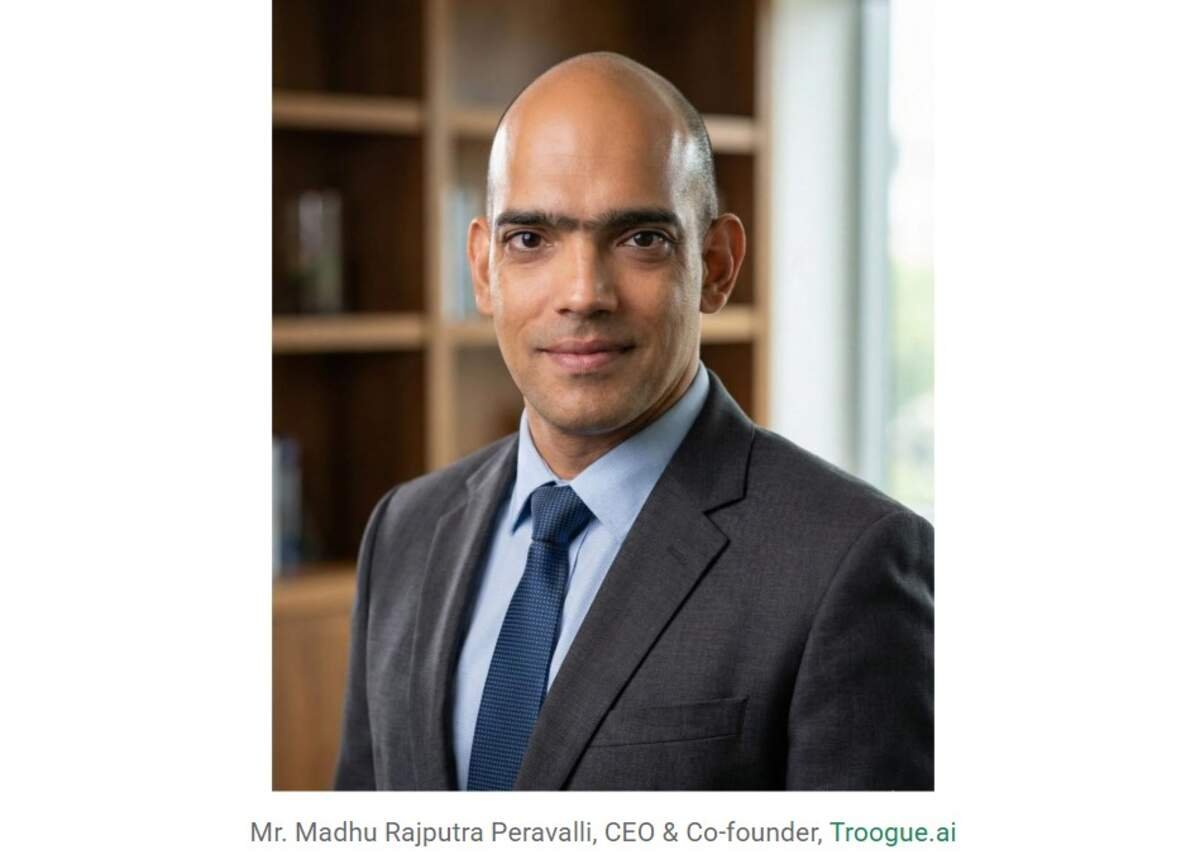
Troogue.ai CEO Madhu Rajputra Peravalli shares insights on transforming enterprise hiring through capability validation, AI-enabled talent solutions, and platform-led growth.
- What was your moment of inspiration for Troogue?
There was no single moment. It was years of watching the same thing repeat.
Enterprises had demand. Professionals had capability. The system between them was broken.
Hiring depended on resumes, vendor layers, referrals, and long interview cycles. Real capability got discovered too late — sometimes after deployment, sometimes after the damage was done.
And on the other side, strong professionals kept getting missed because of resume formatting, network gaps, or keyword visibility. That never made sense to me.
The question was simple: why are we still hiring based on what people claim, when we can evaluate what they can actually do?
That question became Troogue. Right Talent, Right Place — not as a tagline, but as a genuine belief about how this industry needs to work.
- Was there an existing model you referenced? How did you envision the design?
No exact model existed. And that was both the opportunity and the problem.
Troogue is not a job portal. Not a staffing company. Not just an assessment tool. We called it a capability marketplace — because that distinction actually matters.
A job portal gives you profiles. A staffing company gives you people. But enterprises don’t want profiles or people in isolation. They want confidence that the person can deliver.
So the platform had to solve for trust.
Three things had to work from day one. Validate capability — not through MCQs, but through scenario-based evaluation, real problem-solving, and role readiness. Understand enterprise demand properly — because “Java developer” is never the full picture; there’s context, domain, communication, deployment readiness. And bring structure to the wider ecosystem — internal teams, contractors, agencies, benches — which enterprises already use but can’t see clearly.
The design was not built around hiring. It was built around capability assurance.
We’re not trying to make old hiring slightly faster. We’re trying to change how enterprises access, validate, and deploy talent.
- What were the most critical challenges and how did you navigate them?
The biggest challenge was not technology. It was behaviour change.
Enterprises know the traditional model is inefficient. They know interviews are inconsistent. They know resumes are unreliable. But knowing something is broken and actually changing how you operate — those are two very different things.
That was challenge one: trust. Proving that a platform-led model can work in a space that has been relationship-led and vendor-led for decades.
Operationally, we were building both sides simultaneously. Enterprises wanted validated talent. Professionals and agencies had to understand why platform-led visibility mattered. Demand and supply don’t grow in equal proportion. You keep balancing.
Financially, we stayed disciplined. No building on hype. Revenue, traction, repeat usage — those were the anchors. That discipline kept us close to real business problems.
Strategically, the hardest call was balancing services and platform growth. Services bring revenue. Services open enterprise doors. But if you’re not careful, you get trapped there.
Our rule: every engagement had to strengthen the platform. Every deployment had to improve our intelligence. Services were a bridge, not the destination.
The journey hasn’t been easy. But it’s been real. And that matters more than smooth.
- How has your understanding of the target market evolved?
Initially, we thought enterprises needed faster access to talent.
We were wrong about the core problem.
It wasn’t speed. It was confidence.
Enterprises don’t want ten profiles quickly. They want to know which one can actually deliver. They want to reduce interview fatigue. Avoid bad deployments. Remove guesswork.
Speed without quality just means you’re moving faster towards the wrong decision.
So Troogue evolved — from talent discovery to capability validation and deployment. Assessments became more scenario-based. Reports became more decision-oriented, because enterprises don’t need more data. They need clarity.
Another big learning: enterprises don’t operate through one clean talent channel. Internal teams, vendors, agencies, contractors, partner benches — all fragmented. So we started thinking of Troogue as an ecosystem layer that brings quality and transparency across all of those channels.
And then AI became mainstream. Enterprises started asking harder questions about productivity, cost, capability, outcomes. That actually made Troogue more relevant — because our core belief was always that capability should be proven, not assumed.
The question shifted from “how do we help companies hire faster?” to “how do we help companies access proven capability with confidence?”
That’s a much bigger problem. And a much better one to be solving.
- How would you describe your leadership style and how it works with your co-founders?
I’m direct. Vision-led. Very close to the market.
I look at where the industry is heading, what customers are genuinely struggling with, and where Troogue needs to be ahead of that. I don’t believe in building something because it sounds good. It has to solve a real problem and move the business forward.
In a startup, co-founders can’t think identically. That might feel comfortable — but it’s dangerous. You need different lenses. Different angles. Different honest voices.
My role is often to connect everything back to the bigger picture — market relevance, growth, positioning, long-term direction.
Disagreements happen. They should. If three founders agree on everything all the time, someone isn’t being honest.
How we resolve it: the anchor is always the company. Not ego. Not title. Not who said it first.
We look at the customer, the data, the business priority. Sometimes the best idea wins. Sometimes the most practical one does. Sometimes the market just decides for you.
Once the mission is bigger than any one founder, disagreements become manageable.
- What are the most important lessons from your entrepreneurial journey and your advice to aspiring entrepreneurs?
The biggest lesson: entrepreneurship is not about the idea. It’s about staying long enough with the problem.
Ideas are easy to romanticise. Execution is where reality hits.
Customers won’t move just because you believe your product is good. Teams won’t align just because the vision is exciting. Markets won’t shift just because you can see the future earlier than others. You have to keep proving. Every day.
Revenue matters. More than most founders want to admit early on. Without it, everything else — product, brand, culture, vision — is just theory. Revenue gives you oxygen. It gives you options.
Timing matters too. Sometimes the market isn’t ready the way you want it to be. That doesn’t mean the idea is wrong. It means you need patience, sharper positioning, and better proof.
My advice, simply:
Don’t start up because the idea sounds exciting. Start because the problem refuses to leave your head.
Stay close to customers. They’ll teach you more than any pitch deck.
Be financially disciplined. Burning money is not strategy.
Don’t confuse activity with progress. Meetings, noise, announcements — none of it matters if the business isn’t moving.
And build conviction. Not blind confidence. Conviction.
There will be days when people doubt you, customers delay, partners don’t move, and your own team questions the direction. Those days are the test.
For us, Troogue is still the journey. But the belief is clear: the future of enterprise work will be platform-led, capability-driven, and AI-enabled.
We’re building for that future.

