

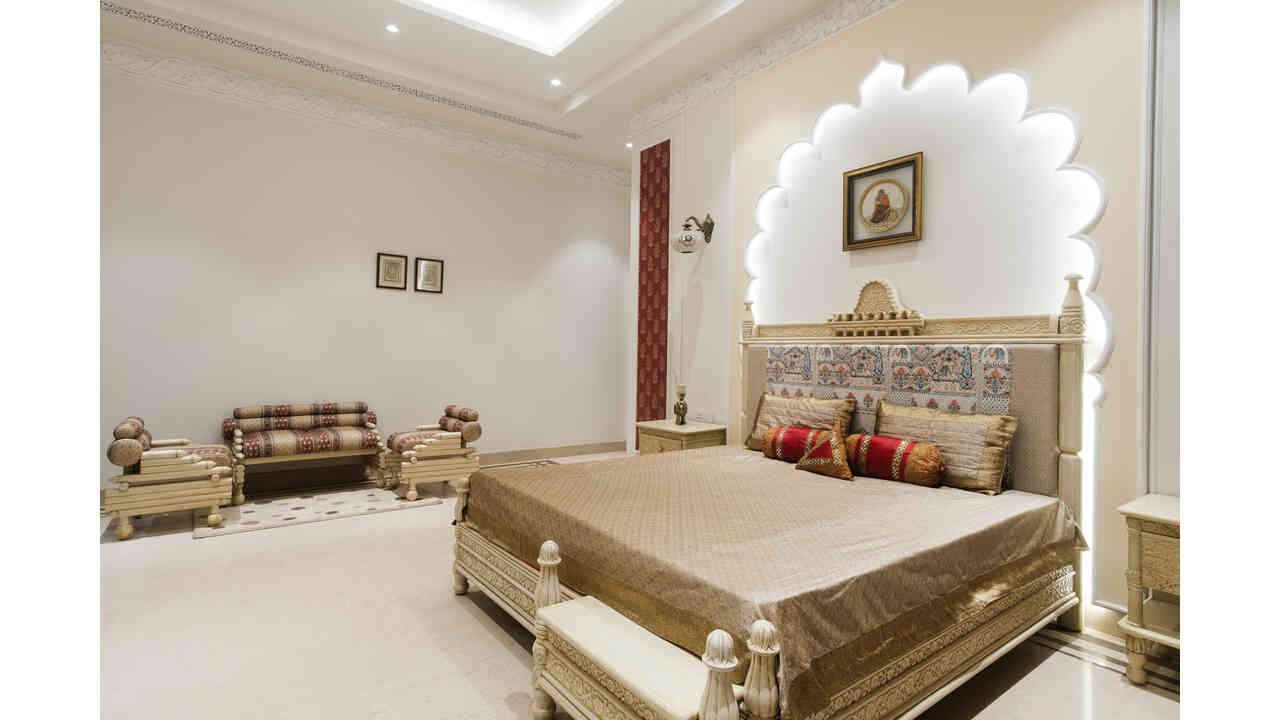
Bringing colour into a home does not require dramatic walls or bold paint choices. Vibrancy, when handled well, is measured. It comes from layering materials, textures, and accents over a calm foundation so that energy builds gradually rather than all at once.
The starting point is always a composed base. In our projects like Lumora Residency and Katyal Residence, neutral backdrops create spatial clarity and a natural sense of breathing room. Soft beiges, warm greys, and muted undertones form a calm foundation that supports the overall scheme rather than dominating it. Against this quiet canvas, bolder accents and material contrasts can stand out with intention instead of competing for attention.
Design decisions extend beyond colour alone. Integrated storage and streamlined furniture help maintain visual order, preventing everyday clutter from interrupting the aesthetic flow. The result is an interior that feels balanced, cohesive, and quietly confident, where vibrancy is introduced with purpose rather than excess.
From there, colour can be introduced through detail. Metallic finishes such as brass inlays, golden-tinted mirrors, and sculptural pendant lights, as seen in Heritage Haus, add warmth and luminosity without overwhelming the palette. These surfaces respond to changing light throughout the day, creating depth through reflection and glow rather than pigment. “True vibrancy emerges not from bold paint, but from layered textures, luminous metallics, thoughtful lighting, and living greenery,” says Ar. R.K. Malik, Principal Architect and Founder of R.K. Malik and Associates.
Texture becomes another powerful carrier of colour. Patterned stone flooring in Katyal Residence introduces rhythm without excess. On the façade of Heritage Haus, the interplay of mint and brown stone generates contrast while remaining harmonious. Inside, velvet upholstery, layered fabrics, and soft drapery enrich the atmosphere, proving that colour can be experienced through touch as much as sight. What this really means is that materiality does the work that paint often tries to do alone.
Lighting and art also play a defining role. A sculptural chandelier, an illuminated stair tread, or a carefully curated artwork can anchor a room visually. By directing attention to specific focal points, the design avoids scattered décor and instead feels deliberate. “Balance is achieved when every colourful element has a purpose,” says Ar. R.K. Malik. The goal is not to fill space, but to compose it.
Biophilic elements offer one of the most effortless ways to introduce vibrancy. Indoor plants, terracotta planters, herb gardens, and indigenous greenery infuse interiors with organic colour that feels alive yet calming. Unlike artificial ornamentation, greenery evolves with time and light, reinforcing a sense of connection to nature.
When colour is layered through materials, light, texture, and nature rather than applied excessively, interiors feel energetic yet controlled. The result is a vibrant home without being chaotic, expressive without being overwhelming, and refined without losing warmth.

