

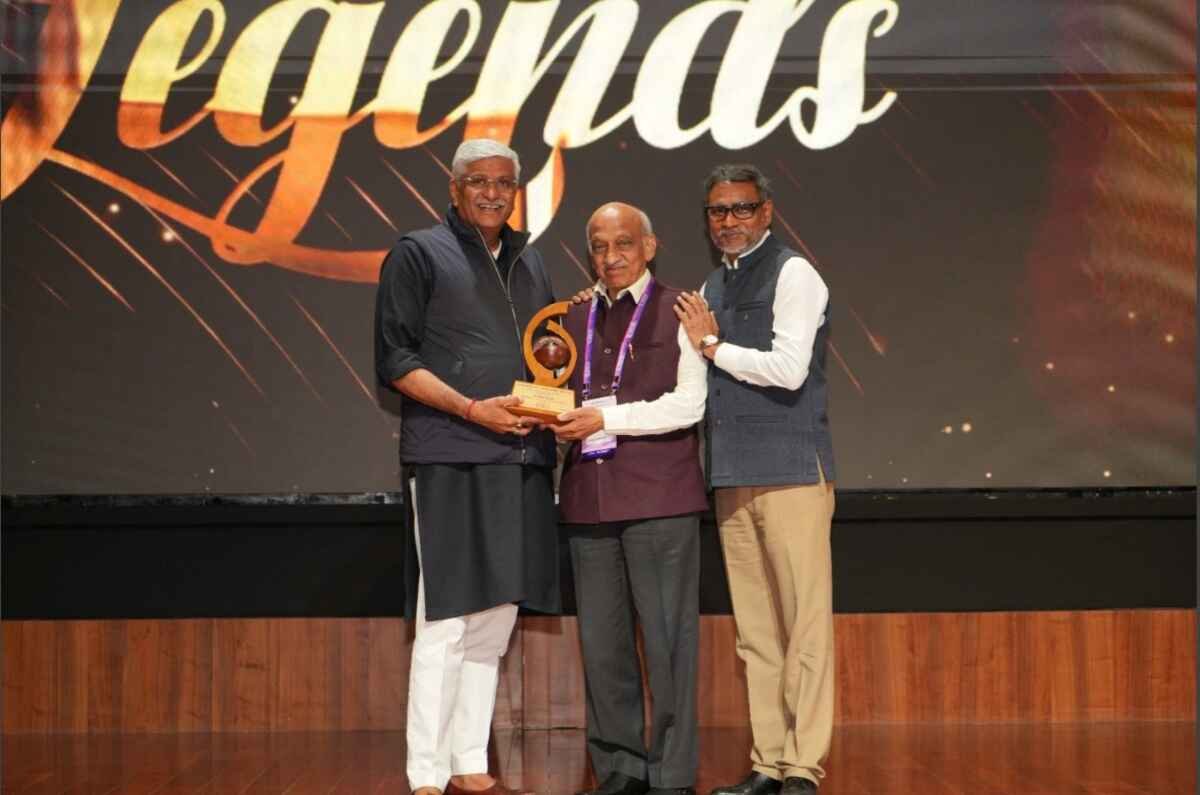
New Delhi, 2nd December 2025: The GeoSmart India Conference and Expo 2025 organised by GeoSpatial World held at Bharat Mandapam, New Delhi, featured a special session titled “Living Legends: Space and Geospatial Industry Trajectory.” The session celebrated the visionaries whose pioneering work shaped India’s remarkable journey from manual mapping to becoming a global leader in the space and geospatial domains.
The session brought together distinguished scientists, technologists, and entrepreneurs who transformed India’s geospatial and space ecosystem through innovation, determination, and foresight. It traced the nation’s evolution from paper-based cartography to advanced satellite systems that now support governance, science, and sustainable development.
Addressing the gathering, Shri Gajendra Singh Shekhawat, Hon’ble Union Minister of Culture and Tourism, Government of India, underlined the human purpose of technology, stating that “geospatial technology today stands at the heart of India’s transformation; connecting villages, guiding cities, empowering farmers, preserving heritage, and saving lives during disasters.” He added that under Hon’ble Prime Minister Narendra Modi’s leadership, initiatives such as Gati Shakti, Swamitva, and Mera Gaon Meri Dharohar are driving precision governance and sustainable progress, positioning geospatial innovation as a foundation for “a safer, smarter, and more compassionate planet.”
Speakers reflected on how decades of scientific discovery, policy evolution, and industry participation have expanded India’s technological frontiers. Dr. Manosi Lahiri, Founder and CEO of ML Infomap, recounted the early transformation of the field, observing that “from manual surveys to digital cartography and GIS, technology has revolutionized mapping and spatial analysis.” Her remarks highlighted how this evolution turned static maps into dynamic tools for planning, decision-making, and development.
Building on this vision, Shri V. S. Kiran Kumar (Padma Bhushan), Former Secretary, Department of Science and Technology, spoke of India’s rise from a developing nation to a space leader, noting that “India’s transformation reflects the foresight of pioneers like Dr. Vikram Sarabhai.” He emphasized that new technologies must continue to act as drivers of societal advancement, good governance, and sustainability.
Dr. B. V. R. Mohan Reddy (Padma Shri), Founder and Former Executive Chairman of Cyient, highlighted India’s emergence as a data-driven economy, observing that geospatial technology has become an essential layer across industries. He said that as artificial intelligence, sensors, and space technologies come together, success will depend on India’s ability to continuously innovate and adapt to an ever-changing environment.
From a scientific perspective, Dr. Shailesh Reddy (Padma Shri), Director, National Institute of Advanced Studies, pointed out that “geospatial technology and Earth system science have revolutionized our understanding of the planet, from ocean tides and cyclone formation to ecosystem monitoring and climate change.” He emphasized that this knowledge is now central to achieving sustainability and resilience in global development.
Adding an applied industry viewpoint, Shri Saroop Chand, Director, Adroitec Information Systems, reflected on how technology has bridged the gap between data and action. He described how integrating GIS with infrastructure projects and creating 3D-printed terrain models for defense planning have strengthened India’s capabilities in precision mapping and self-reliant innovation.
The Living Legends Awards were presented by Chief Guest Shri Gajendra Singh Shekhawat, Honourable Union Minister of Culture and Tourism, Government of India, in recognition of eight pioneering individuals whose lifelong contributions have shaped India’s geospatial and space ecosystem. The awardees included Dr. Shailesh Nayak, Prof. V. S. Ramamurthy, Dr. Manosi Lahiri, Shri A. S. Kiran Kumar, Dr. B. V. R. Mohan Reddy, Shri K. K. Singh, Shri Rajendra Pawar, and Shri Saroop Chand, each honoured for advancing innovation, research, and leadership that positioned India as a global geospatial powerhouse.
The session concluded with a collective reflection on India’s transformation from traditional surveys and manual cartography to digital twins and intelligent satellite systems, symbolizing how far the country has come in blending technology with purpose.
By honouring these stalwarts, GeoSmart India 2025 celebrated not only India’s scientific legacy but also its enduring spirit of innovation and collaboration, reaffirming the nation’s commitment to a future where geospatial and space technologies power inclusive growth, sustainability, and global leadership.

